

Introduction
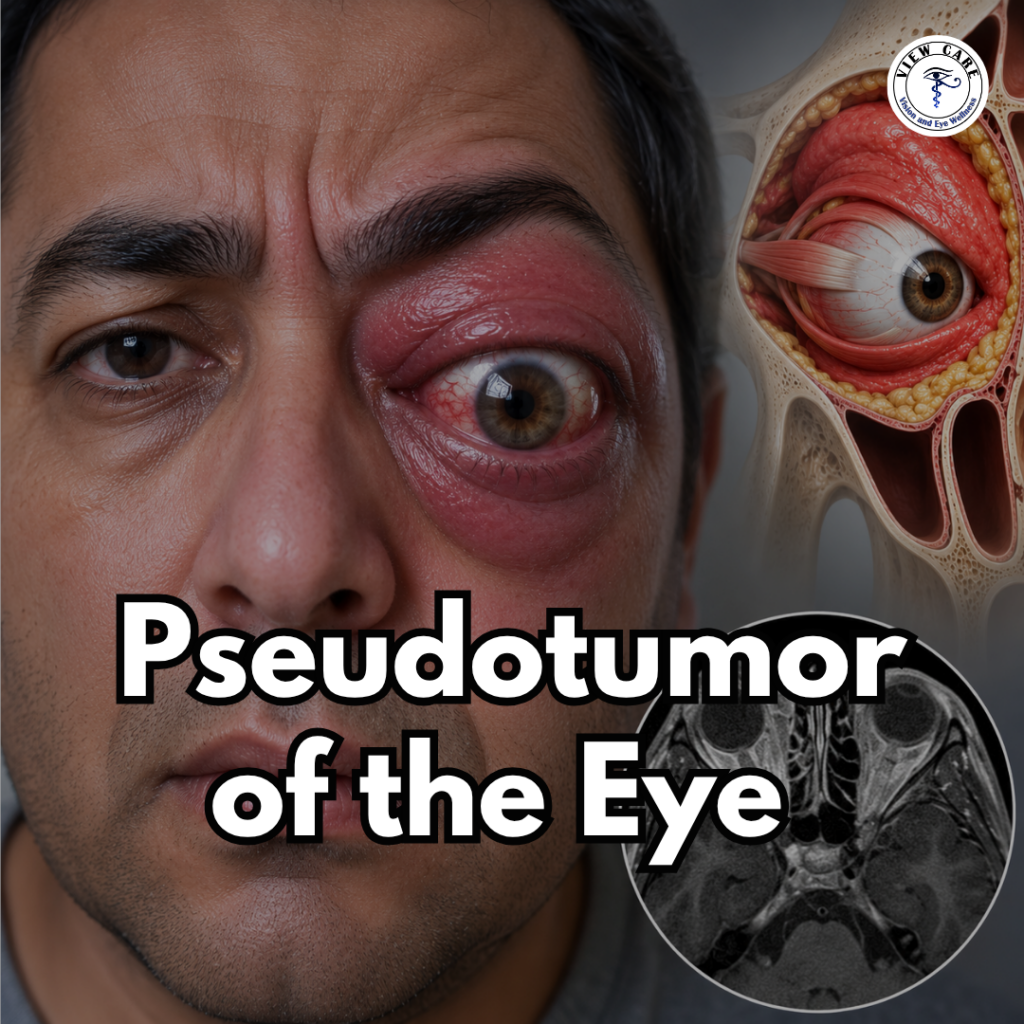
The word “pseudotumor” can sound frightening. Many
people immediately think of cancer. However, a pseudotumor of the eye,
commonly called orbital pseudotumor, is not a true cancerous tumor.
Today, doctors often call this condition idiopathic
orbital inflammation or non-specific orbital inflammation. In simple
words, it is swelling and inflammation inside the eye socket without an obvious
cause. The eye socket contains the eyeball, muscles that move the eye, nerves,
blood vessels, tear gland, fat, and other supporting tissues. When these
tissues become inflamed, symptoms can develop quickly.[1,2]
A person may experience eye pain, swollen eyelids, redness,
double vision, difficulty moving the eye, or a bulging eye. In severe cases,
vision may be affected.
Because these symptoms can also occur in infections,
thyroid-related eye disease, immune disorders, and true tumors, a timely
examination by an Eye specialist or Ophthalmologist is important.
A detailed Eye checkup and appropriate Eye test can help identify
the real cause.
What Exactly Is a Pseudotumor of the Eye?
An orbital pseudotumor is an inflammatory condition
affecting one or more tissues inside the eye socket. The term “pseudo” means
false, so the name literally suggests a “false tumor.”
It may look like a tumor during an examination or scan
because inflamed tissue can become thick and swollen. However, it is not the
same as cancer.
The inflammation may involve:
- Muscles
that move the eye
- Tear
gland
- Fat
behind the eye
- Tissues
around the optic nerve
- Several
areas of the eye socket together
The symptoms depend on which tissues are involved and how
severe the inflammation is.
Is It the Same as Pseudotumor Cerebri?
No. This is an important difference.
Orbital pseudotumor affects tissues inside the eye
socket. Pseudotumor cerebri, now often called idiopathic intracranial
hypertension, involves raised pressure around the brain.
These are separate conditions and require different tests
and treatments.
What Causes a Pseudotumor of the Eye?
In many cases, the exact cause is unknown. This is why
doctors use the word “idiopathic.”
Researchers believe that abnormal immune activity may play a
role. The immune system normally protects the body from infections. Sometimes,
however, inflammation may become misdirected and affect healthy tissues inside
the eye socket.[1,2]
Before confirming orbital pseudotumor, doctors may need to
rule out other conditions, including:
- Infection
around the eye
- Thyroid-related
eye disease
- Immune-related
disorders
- IgG4-related
disease
- Certain
inflammatory blood vessel diseases
- Lymphoma
- Other
orbital tumors
- Tear
gland disorders
- Problems
related to nearby sinuses
For this reason, self-diagnosis is not safe. A swollen,
painful, or protruding eye should be assessed by an experienced Eye doctor.
Who Is at Risk?
Orbital pseudotumor does not have a simple list of lifestyle
risk factors. It can affect people of different ages, including children,
although it is more commonly discussed in adults.[1,2]
Possible risk factors or associations include:
1. Abnormal Immune Activity
Because this is an inflammatory condition, unusual immune
activity may contribute in some patients.
2. History of Inflammatory Illness
Some people with orbital inflammation may have another
inflammatory or immune-related condition.
3. Previous Orbital Inflammation
The condition can return after treatment. People who have
had a previous episode may experience recurrence.
4. No Clear Risk Factor
Many patients are otherwise healthy and have no obvious
trigger. This is one reason the condition can be difficult to predict.
What Are the Symptoms of a Pseudotumor of the Eye?
Symptoms may appear suddenly over hours or days, or develop
more slowly. Common symptoms include:
Eye Pain
Pain around or behind the eye is common. It may become worse
when the person looks up, down, or sideways.
Swollen Eyelids
The upper or lower eyelid may become puffy, sometimes quite
noticeably.
Eye Redness
The eye and surrounding tissues may appear red and
irritated.
Bulging Eye
Inflammation behind the eyeball can push it forward. A newly
protruding eye should always be checked promptly.
Double Vision
If inflammation affects the eye muscles, the two eyes may
stop moving together normally.
Painful or Restricted Eye Movement
Moving the affected eye may hurt, or the eye may not move
fully in certain directions.
Blurred or Reduced Vision
Vision may become blurry if severe inflammation affects
important structures, especially the optic nerve.
Pressure Behind the Eye
Some people describe heaviness, fullness, or pressure inside
the eye socket.
What Signs May an Eye Doctor Find?
During an Eye checkup, an Ophthalmologist may
find:
- Eyelid
swelling
- Eye
redness
- Forward
displacement of the eye
- Reduced
eye movement
- Abnormal
eye alignment
- Reduced
vision
- Changes
in colour vision
- Abnormal
pupil responses
- Swelling
of the eye surface
- Signs
of pressure on the optic nerve
A complete Eye test is important because deeper
inflammation may not always be obvious from appearance alone.
How Is Pseudotumor of the Eye Diagnosed?
There is no single home test for orbital pseudotumor.
Diagnosis usually combines symptoms, examination findings, scans, and sometimes
blood tests or biopsy.
It is often considered a diagnosis of exclusion,
meaning doctors must first consider other possible causes.[1-4]
1. Medical History
The doctor may ask:
- When
did symptoms begin?
- Is
there pain?
- Does
eye movement hurt?
- Is
vision blurred?
- Is
there double vision?
- Is
there fever?
- Have
symptoms occurred before?
- Is
there a history of thyroid or immune disease?
2. Detailed Eye Examination
The Eye specialist may check:
- Vision
- Pupils
- Eye
movements
- Eye
alignment
- Colour
vision
- Eye
pressure
- Retina
- Optic
nerve
3. CT Scan or MRI
Imaging can show which tissues are swollen and whether
muscles, the tear gland, deeper orbital tissues, or nearby areas are involved.
A scan may also help doctors look for infection, a true
mass, or another cause. However, a scan alone does not always confirm orbital
pseudotumor.
4. Blood Tests
Blood tests may be recommended when doctors suspect thyroid
disease, inflammation, infection, or another underlying condition.
5. Biopsy
Not every patient needs a biopsy. It may be considered when:
- The
diagnosis is uncertain
- The
scan looks unusual
- A
true tumor must be ruled out
- Treatment
does not work as expected
- The
condition keeps returning
What Are the Treatment Options?
Treatment depends on the severity of inflammation, the
tissue involved, vision changes, overall health, and whether the condition has
returned.
1. Corticosteroids
Corticosteroids are commonly used to reduce inflammation.
They may be given as tablets or, in severe cases, through a vein under medical
supervision.
Many patients improve, but steroids can cause side effects
such as:
- Increased
blood sugar
- Increased
blood pressure
- Weight
gain
- Sleep
or mood changes
- Stomach
problems
- Increased
infection risk
- Bone
weakening with long-term use
A common misconception is that improvement with steroids
automatically proves orbital pseudotumor. This is not correct. Other conditions
can also temporarily improve with steroids.
Never start or stop steroid treatment without medical
advice.
2. Other Anti-Inflammatory Medicines
Selected mild cases may be treated with non-steroid
anti-inflammatory medicines. These are not suitable for everyone and should be
used only after medical advice.
3. Steroid-Sparing Medicines
If the condition keeps returning, does not respond well, or
requires prolonged treatment, doctors may consider medicines that control
excessive immune activity.
These medicines need careful monitoring.
4. Radiation Therapy
Low-dose radiation may be considered in selected difficult
or recurrent cases. It is not a routine first treatment for everyone.
5. Targeted Immune Therapy
Certain advanced medicines may be considered in severe or
treatment-resistant cases. These treatments are usually managed by specialists.
6. Surgery
Surgery is not required for every patient. It may be used
for:
- Taking
a biopsy
- Managing
selected pressure-related problems
- Treating
certain chronic complications
- Clarifying
an uncertain diagnosis
When Should You Seek Medical Help?
Contact an Eye specialist promptly if you notice:
- Sudden
swelling around one eye
- New
eye bulging
- Severe
eye pain
- Pain
when moving the eye
- New
double vision
- Blurred
or reduced vision
- Difficulty
moving the eye
- Rapidly
increasing redness or swelling
Seek urgent care if vision suddenly decreases, swelling
becomes severe, the eye protrudes rapidly, or pain occurs with fever.
These symptoms should not be treated only with home remedies
or over-the-counter eye drops.
What Complications Can Occur?
With timely treatment, many patients improve. However,
possible complications include:
Vision Loss
Severe inflammation may affect or compress the optic nerve,
which carries visual information from the eye to the brain.
Persistent Double Vision
Inflammation of the eye muscles can disturb eye alignment.
Restricted Eye Movement
Long-term inflammation or scarring may limit movement.
Recurrence
The condition can return after initial improvement.
Chronic Inflammation
Some patients develop long-lasting inflammation or firm
scar-like tissue, making treatment more difficult.
Treatment Side Effects
Steroids and immune-modifying medicines may cause side
effects, so regular monitoring is essential.
Delayed Diagnosis of Another Disease
One of the greatest risks is assuming that every swollen eye
is a pseudotumor. Infection, immune disease, and true tumors can sometimes look
similar.
Two Hopeful Treatment Stories
Note: The following are fictional educational examples
based on typical clinical situations. They are not real patient testimonials
and do not guarantee results.
Story 1: Neha’s Sudden Eye Swelling
Neha, a 35-year-old professional, developed pain behind her
right eye. Within two days, her eyelid became swollen, and moving the eye was
uncomfortable.
She initially blamed lack of sleep. However, when mild
double vision appeared, she visited an Eye doctor.
After a complete Eye checkup, vision assessment, and
imaging, her medical team considered orbital inflammation after evaluating
other possible causes. She began treatment under specialist supervision.
Over the following days, her pain reduced and the swelling
gradually improved. She continued follow-up instead of stopping treatment
early. Soon, she returned to her regular routine.
Her story highlights the value of timely evaluation.
Story 2: Rajesh’s Bulging Eye
Rajesh, aged 48, noticed that his left eye looked slightly
more prominent than the other. He also felt pressure behind the eye and
occasional blurred vision.
Instead of waiting, he visited an Eye hospital. The
team performed a detailed examination and recommended imaging. Other possible
causes were considered before treatment began.
With specialist-guided care and regular monitoring, his
symptoms gradually improved.
His experience shows why a new bulging eye should never be
ignored.
Can Pseudotumor of the Eye Be Prevented?
There is no guaranteed way to prevent idiopathic orbital
inflammation because its exact cause is often unknown.
However, you can reduce the risk of delayed diagnosis by:
- Not
ignoring persistent eye pain
- Seeking
help for unexplained swelling
- Getting
new double vision checked
- Reporting
a newly bulging eye
- Attending
follow-up appointments
- Taking
medicines exactly as prescribed
- Avoiding
self-medication with steroids
Why Is Specialist Eye Care Important?
Orbital pseudotumor can resemble many other diseases. Proper
care may require examination of vision, eye movements, the optic nerve, and
imaging results.
If you are searching for an Eye specialist Delhi, Eye
specialist Mayur Vihar Phase 1, Eye specialist Laxmi Nagar, Eye
hospital Delhi, or Eye hospital in Delhi, focus on qualifications,
diagnostic facilities, clear communication, and follow-up care.
At View Care, patients can seek professional
evaluation for eye symptoms and appropriate guidance based on their individual
findings.
People often search phrases such as Best eye hospital in
Delhi, Best eye specialist near me, or Top 5 eye doctor near me.
However, online rankings alone should not decide medical care. The right choice
depends on professional qualifications, relevant experience, proper diagnosis,
and continuity of care.
Frequently Asked Questions
Is pseudotumor of the eye cancer?
No. It is an inflammatory condition, not a true cancer.
However, proper evaluation is needed because some tumors can look similar.
Can it cause blindness?
Severe cases may threaten vision if the optic nerve is
affected or compressed.
Is it contagious?
No. Idiopathic orbital inflammation is not considered
contagious.
Can it return after treatment?
Yes. Recurrence is possible, which is why follow-up matters.
Do all patients need surgery?
No. Many patients are treated with medicines. Surgery may be
needed for biopsy or selected complications.
Can normal eye drops cure it?
Usually not. The inflammation occurs inside the eye socket,
so ordinary lubricating or redness-relief drops do not treat the underlying
condition.
Final Thoughts
A pseudotumor of the eye can sound alarming, but it is not a
true tumor. It is an inflammatory condition affecting tissues inside the eye
socket.
It may cause eye pain, swelling, redness, double vision,
restricted movement, a bulging eye, or reduced vision. The main challenge is
that these symptoms can overlap with infection, thyroid-related eye disease,
immune disorders, and true tumors.
If you develop sudden eye swelling, unexplained pain, double
vision, a bulging eye, or any change in vision, arrange a prompt Eye checkup
with a qualified Ophthalmologist.
For patients in Mayur Vihar Phase 1, Patparganj, Laxmi
Nagar, and nearby areas, View Care offers professional eye evaluation
and guidance based on individual needs.
Medical Disclaimer: This article is for general
education only. It does not replace diagnosis, examination, or treatment by a
qualified medical professional.