

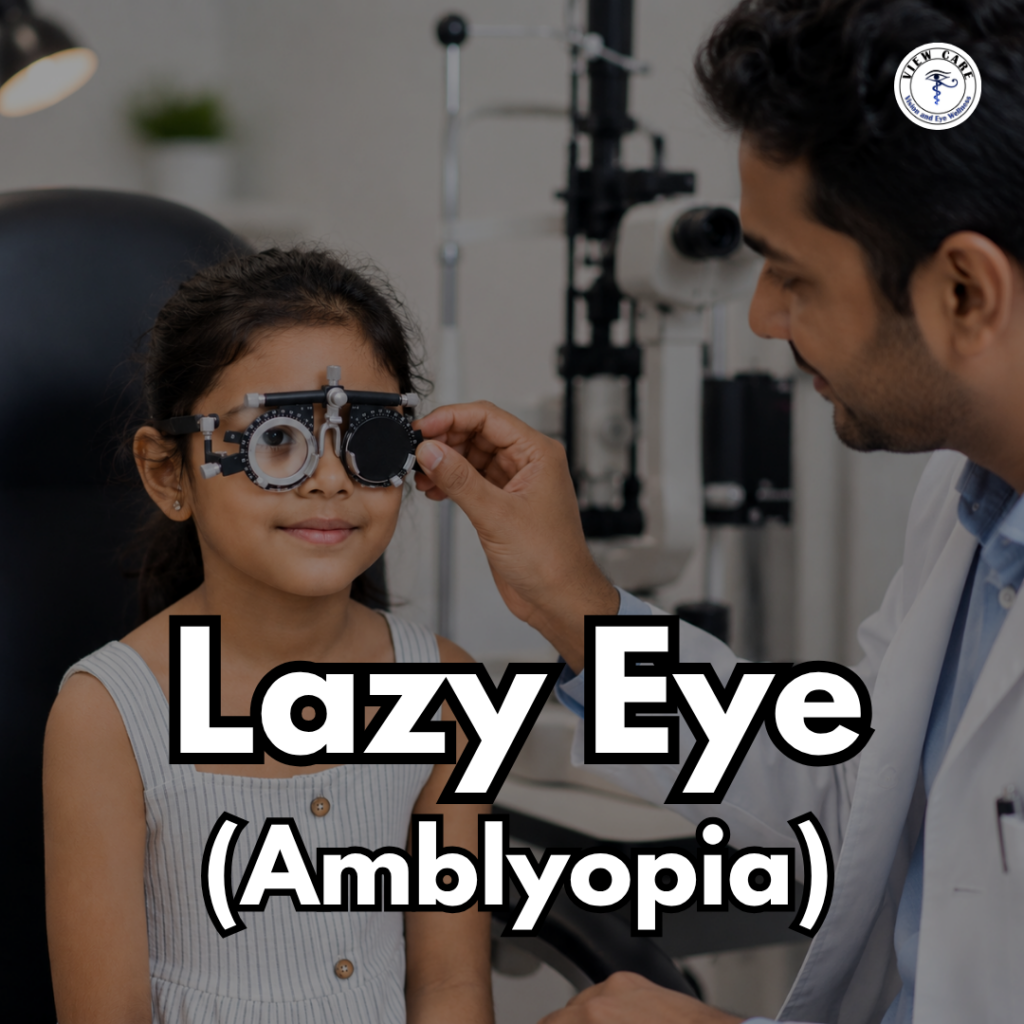
Introduction
Have you ever noticed that one of your child’s eyes seems to wander or doesn’t focus properly? Or perhaps someone told you that your child has a “lazy eye.” Hearing this can naturally make any parent worried.
The good news is that Lazy Eye (Amblyopia) is one of
the most treatable childhood vision problems—especially when diagnosed early.
Many children who receive timely treatment grow up with normal or near-normal
vision.
Unfortunately, many parents mistake lazy eye for a cosmetic
issue, believing their child will “grow out of it.” In reality,
delaying treatment can permanently affect vision.
In this blog, we’ll explain everything about Lazy Eye in
simple language—from causes and symptoms to treatment options and inspiring
success stories.
What Is Lazy Eye (Amblyopia)?
Lazy Eye, medically known as Amblyopia, is a condition where one eye develops weaker vision than the other. The eye itself usually looks perfectly healthy. The problem lies in how the brain processes images from the weaker eye.
Instead of using both eyes equally, the brain starts relying more on the stronger eye and gradually ignores signals coming from the weaker one. Over time, vision in the weaker eye becomes poorer because the brain doesn’t “practice” using it. This is why early treatment is extremely important.
How Does Normal Vision Develop?
When a baby is born, the eyes and brain learn to work together over several years. Both eyes send clear images to the brain.
The brain combines these images to create:
- Sharp
vision
- Good
depth perception
- Proper
eye coordination
- Better
hand-eye coordination
If one eye sends a blurry or misaligned image, the brain starts ignoring it. Eventually, that eye becomes “lazy.”
Who Is More Likely to Develop Lazy Eye? (Risk Factors)
Some children have a higher chance of developing amblyopia.
Common risk factors include:
- Premature
birth
- Low
birth weight
- Family
history of lazy eye
- Family
history of squint
- Significant
difference in vision between both eyes
- Congenital
cataract
- Drooping
eyelid
- Developmental
delays
- Eye
muscle imbalance
- Severe
refractive error
Children with these risk factors should have an early Eye
checkup by an experienced Eye specialist.
What Causes Lazy Eye?
Several eye conditions can lead to amblyopia.
1. Strabismic Amblyopia (Due to Squint)
This is the most common cause. When one eye turns inward, outward, upward, or downward, the brain receives two different images. To avoid double vision, it ignores one eye.
Eventually, that eye becomes lazy.
2. Refractive Amblyopia
Sometimes one eye has much higher power than the other. Examples include:
- High
farsightedness
- High
nearsightedness
- Significant
astigmatism
The brain prefers the clearer image and suppresses the
blurry one.
3. Deprivation Amblyopia
Anything blocking vision during early childhood can cause amblyopia. Examples include:
- Congenital
cataract
- Drooping
eyelid
- Corneal
opacity
- Eye
injury
This type requires urgent treatment.
What Are the Symptoms of Lazy Eye?
Children rarely complain because they don’t realize one eye sees poorly. Parents should watch for:
- One
eye wandering
- Frequent
squinting
- Closing
one eye
- Tilting
the head
- Poor
depth perception
- Difficulty
catching a ball
- Poor
reading performance
- Bumping
into objects
- Reduced
vision in one eye
- Difficulty
judging distance
Sometimes there are no obvious symptoms. Routine Eye test is the only way to detect it.
What Are the Signs an Eye Doctor Looks For?
During an examination, an Ophthalmologist checks for:
- Difference
in visual acuity
- Eye
alignment
- Eye
movement
- Refractive
error
- Eye
muscle balance
- Cataract
- Retinal
problems
- Overall
eye health
These tests are painless and child-friendly.
How Is Lazy Eye Diagnosed?
Diagnosis usually includes:
Vision Testing
Each eye is checked separately.
Refraction Test
This identifies whether glasses are required.
Eye Alignment Test
The doctor checks whether both eyes work together properly.
Dilated Eye Examination
Eye drops help examine the inside of the eye thoroughly.
Can Lazy Eye Be Treated?
Yes.
Treatment is often very successful, especially before the age of 7–8 years. Older children and even some teenagers may also benefit depending on the individual case. The earlier treatment begins, the better the outcome.
Treatment Options for Lazy Eye
1. Prescription Glasses
Many children simply need properly prescribed glasses. Correcting the refractive error allows both eyes to send clearer images to the brain.
2. Eye Patching
A patch is placed over the stronger eye. This forces the brain to use the weaker eye. Initially, children may resist wearing the patch, but with encouragement and consistency, it becomes part of the daily routine.
3. Atropine Eye Drops
Sometimes eye drops are used instead of a patch. The drops temporarily blur the stronger eye, encouraging use of the weaker eye.
4. Vision Therapy
Special visual exercises may improve coordination between
the eyes in selected patients.
5. Surgery
Surgery does not directly cure amblyopia, but it may
be needed to treat the underlying cause, such as:
- Squint
- Cataract
- Drooping
eyelid
After surgery, additional treatments like glasses or
patching are often still required.
How Long Does Treatment Take?
Treatment varies from child to child. Some improve within a few months. Others require treatment for one to three years with regular follow-up visits. Consistency is the key to success.
Can Adults Be Treated?
Although childhood is the ideal time for treatment, adults may still experience improvement with appropriate evaluation and therapy. However, results are generally better when treatment starts early.
What Happens If Lazy Eye Is Left Untreated?
Ignoring amblyopia can lead to lifelong vision problems. Possible complications include:
- Permanent
reduced vision
- Poor
depth perception
- Difficulty
driving
- Problems
in sports
- Increased
dependence on one eye
- Greater
impact if the healthy eye is injured later in life
- Reduced
confidence in some individuals due to visible eye misalignment
When Should You See an Eye Specialist?
Consult an Eye doctor immediately if your child has:
- A
wandering eye
- Difficulty
seeing
- Frequent
eye rubbing
- Head
tilt
- One
eye that appears weaker
- Family
history of lazy eye
- Failed
school vision screening
Regular Eye checkup is recommended even if your child
has no symptoms.
Can Lazy Eye Be Prevented?
Not every case can be prevented, but early detection greatly improves outcomes. Helpful steps include:
- Schedule
eye examinations in early childhood.
- Watch
for unusual eye movements.
- Treat
squint promptly.
- Ensure
children wear prescribed glasses.
- Follow
patching or drop therapy as advised.
- Never
skip follow-up appointments.
Success Story 1: Aarav’s Journey
Four-year-old Aarav struggled to catch a ball and often tilted his head while watching television. His parents brought him to an eye clinic after a preschool vision screening suggested a problem. He was diagnosed with refractive amblyopia.
After receiving glasses and following a patching schedule
for several months, his vision improved significantly. Today, Aarav enjoys
reading, playing cricket, and participating confidently in school activities.
Success Story 2: Meera’s New Confidence
Six-year-old Meera had a noticeable eye turn that made her parents concerned. An eye examination confirmed strabismic amblyopia. She underwent treatment that included glasses, patch therapy, and later surgery to correct the eye alignment.
With regular follow-up and dedication from her family, both
her vision and eye alignment improved remarkably. Meera now participates
happily in dance performances and classroom activities with renewed confidence.
Frequently Asked Questions (FAQs)
Can a lazy eye correct itself?
No. Without proper treatment, it usually does not improve on
its own.
Is patching painful?
No. Eye patches are safe and painless, though children may
need time to get used to them.
Can adults develop lazy eye?
Amblyopia typically develops in childhood, but adults may
still be diagnosed if it was never detected earlier.
Does surgery alone cure lazy eye?
No. Surgery treats the underlying cause, such as squint, but
additional therapy is often required to improve vision.
Is wearing glasses enough?
Some children improve with glasses alone, while others also
need patching, eye drops, or vision therapy.
Final Thoughts
Lazy Eye (Amblyopia) is a common yet highly treatable
childhood eye condition. The most important factor is early diagnosis. A
simple Eye test can identify the problem before it affects lifelong
vision.
If you notice any signs of poor vision or eye misalignment
in your child, don’t wait. Timely care from an experienced Eye specialist
can make a lasting difference.
At View Care Eye Hospital, our experienced Ophthalmologist
and eye care team provide comprehensive Eye checkup, diagnosis, and
personalized treatment plans for children and adults. Whether you’re looking
for an Eye specialist Delhi, an Eye specialist Mayur Vihar Phase 1,
an Eye specialist Laxmi Nagar, or searching for the Best eye
specialist near me, Eye hospital Delhi, Eye hospital in Delhi,
or the Best eye hospital in Delhi, we’re here to help you protect your
family’s vision with compassionate, expert care.